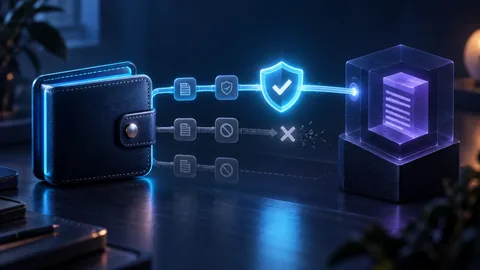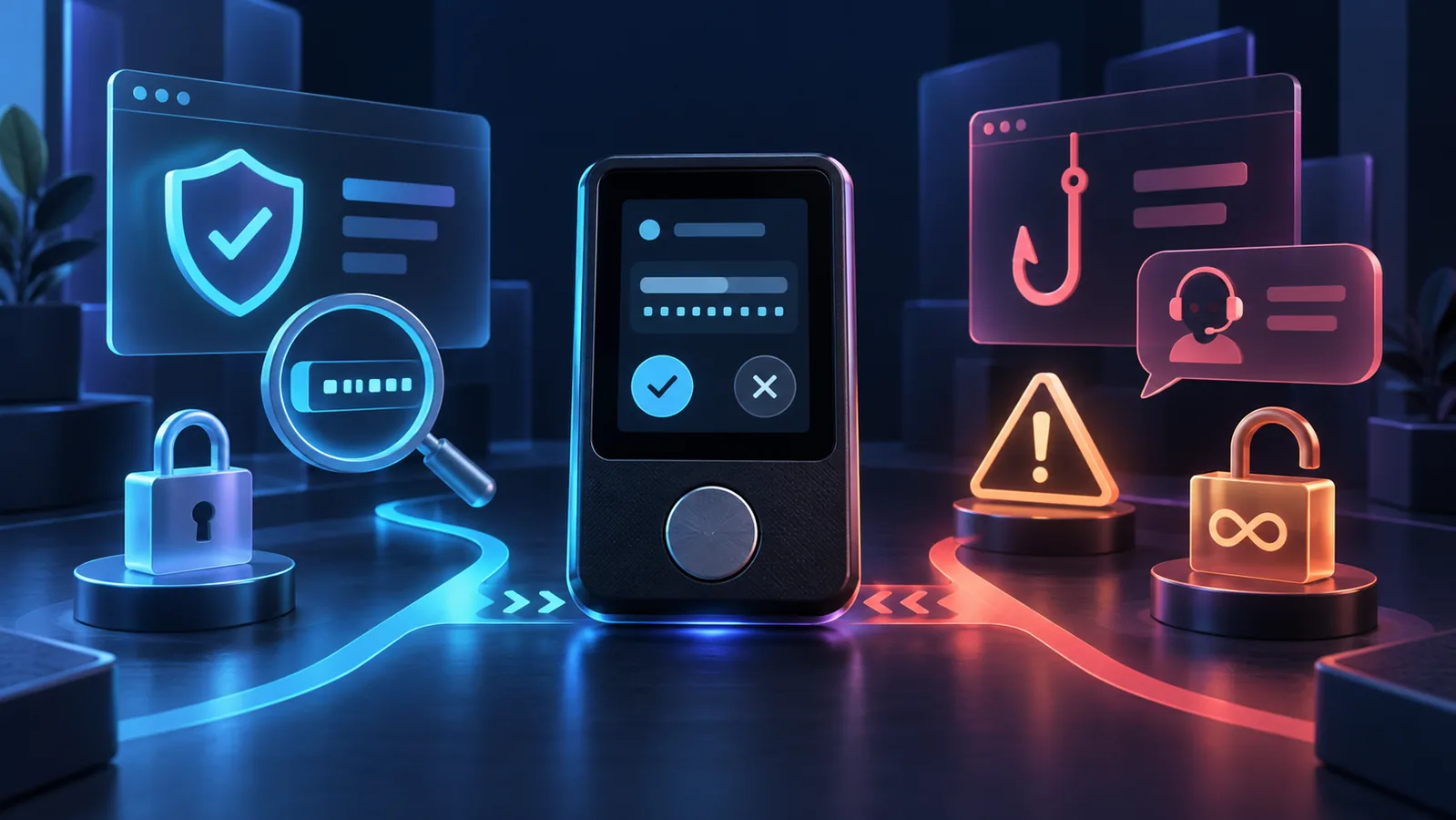
No immediate paid transaction does not mean no risk. Inspect request type, domain, network, contract, spender, value and expiry. Reject requests whose scope your wallet cannot explain.

Read the message

Readable is not safe

Deferred permission
Login
A login message should explain service, account and session context. Do not infer its purpose from the “connect” button: inspect the actual request. A site can substitute a permission message.
Structured data
EIP-712 structures signed fields for display. It does not endorse the contract or site. Compare chain and verifying contract with independently obtained documentation; malicious requests can use a valid format.
Permit
Some tokens allow a signed message to create an allowance. Another party may submit it later under contract rules. Inspect spender, value, nonce and deadline. In ERC-2612, deadline limits permit submission, not automatically the lifetime of the resulting allowance.
NFT operators
An operator approval may cover all your NFTs in one contract, not just one item. Inspect collection, operator and actual rights. “Free” can describe immediate cost without describing authority granted.
After an error
Keep request fields without publishing secrets. Disconnecting, revoking allowance and invalidating signatures are distinct. Response depends on contract and nonce; use a verified procedure. Exposed keys require more than revocation.
A concrete verification
Check domain, network, spender, amount and deadline: a gasless signature can enable later spending.
Hypothetical case: a fee-free signature can authorize spending
A website calls an ERC-2612 signature a login check. Its data instead specifies a spender, a 50-token cap and a deadline. A third party may submit the message to the contract later; no fee at signing does not imply no economic effect. Readable presentation helps inspect the request but does not replace checking the interpreting contract.
- Compare signing domain, chainId and verifying contract with official documentation.
- Read owner, spender, value, nonce and deadline; refuse a scope you do not understand.
- Separate connection, message signature and on-chain transaction: their effects differ.
Before making a change
Revoking with approve(spender, 0) does not consume the nonce of an unused ERC-2612 permit. If that signature remains valid, submitting it can restore an allowance. Check previously granted signatures and token-specific invalidation mechanisms; disconnecting does not cancel them.
- Identify the network, token contract, owner and spender. A token symbol is not enough.
- Read allowance(owner, spender) on the correct contract. It is a spending cap, not the wallet balance.
- After revoking, wait for confirmation and read allowance again. A compromised private key needs a separate response.
Recognize a Sign-In with Ethereum request
For an ERC-4361 sign-in, match the message domain to the website open in the browser. Check the service URI, account address, network and any dates shown. The nonce ties the signature to the sign-in request. Reopen the site from a bookmark if the request came through a shared link. If the wallet shows a spender and an amount it can spend, stop and check what the app is asking you to sign.
Compare signing requests
| Mechanism | Potential authority | Inspect |
|---|---|---|
| Login | Authenticate a session under the message | Service, account, context and duration |
| approve (ERC-20) | Recorded allowance for a spender | Token, spender, amount |
| permit (ERC-2612) | Create allowance after message submission | Contract, value, nonce, deadline |
| setApprovalForAll (ERC-721) | Operator over all your NFTs in the contract | Collection, operator, enable or disable |
Disconnect, revoke or sign: what changes? →
Frequently asked questions
Can a free signature be dangerous?
Yes. It may authorize later actions without an immediate transaction.
Does an expired permit remove an existing allowance?
Not automatically in ERC-2612: its deadline concerns submission.
Does disconnecting cancel signatures?
No. It does not automatically revoke recorded rights or signed messages.
Is a login signature equivalent to EIP-7702 delegation?
No. Login authenticates according to its message; EIP-7702 authorization can delegate account code. Delegation can persist and the original key retains control. Check request type and scope; no immediate gas payment does not imply harmlessness.
Verifiable sources
 Ethereum.org: Signing safety
- EIP-712: Signing domain and replay limits
- ERC-2612: Signed token permits
- ERC-20: Token allowances
- ERC-721: NFT operators
- EIP-7702: Account code delegation
- ERC-4361: Sign-In with Ethereum message fields
Independent educational content reviewed against primary documentation. No personalized recommendation or promise of returns. Updated November 15, 2026
Prepare and continue reading

Useful background
- How to choose a crypto wallet
A crypto wallet manages the keys that authorize operations; it does not physically hold the assets. The right choice depends on use, value at risk and your ability to protect a recovery phrase without sharing it.
- Smart contracts and tokens: read the rules before signing
A smart contract is a program executed by a blockchain. A token is a record managed by a contract under a standard. Before interacting, verify the contract address, network, called functions, approvals, administrator powers and external dependencies.

Continue to the next step
- Token approvals: review and revoke spending permissions
On each network, inspect approved spenders, token and limit. Revoke permissions you no longer need with a trusted tool, then verify the confirmed transaction. If a recovery phrase is exposed, revocation alone is insufficient.
- Recognize and avoid crypto scams
Crypto scams often combine urgency, impersonation and irreversible payment. Stop the conversation, find the service through an independent official channel, never share a recovery phrase and reject guaranteed-return claims.