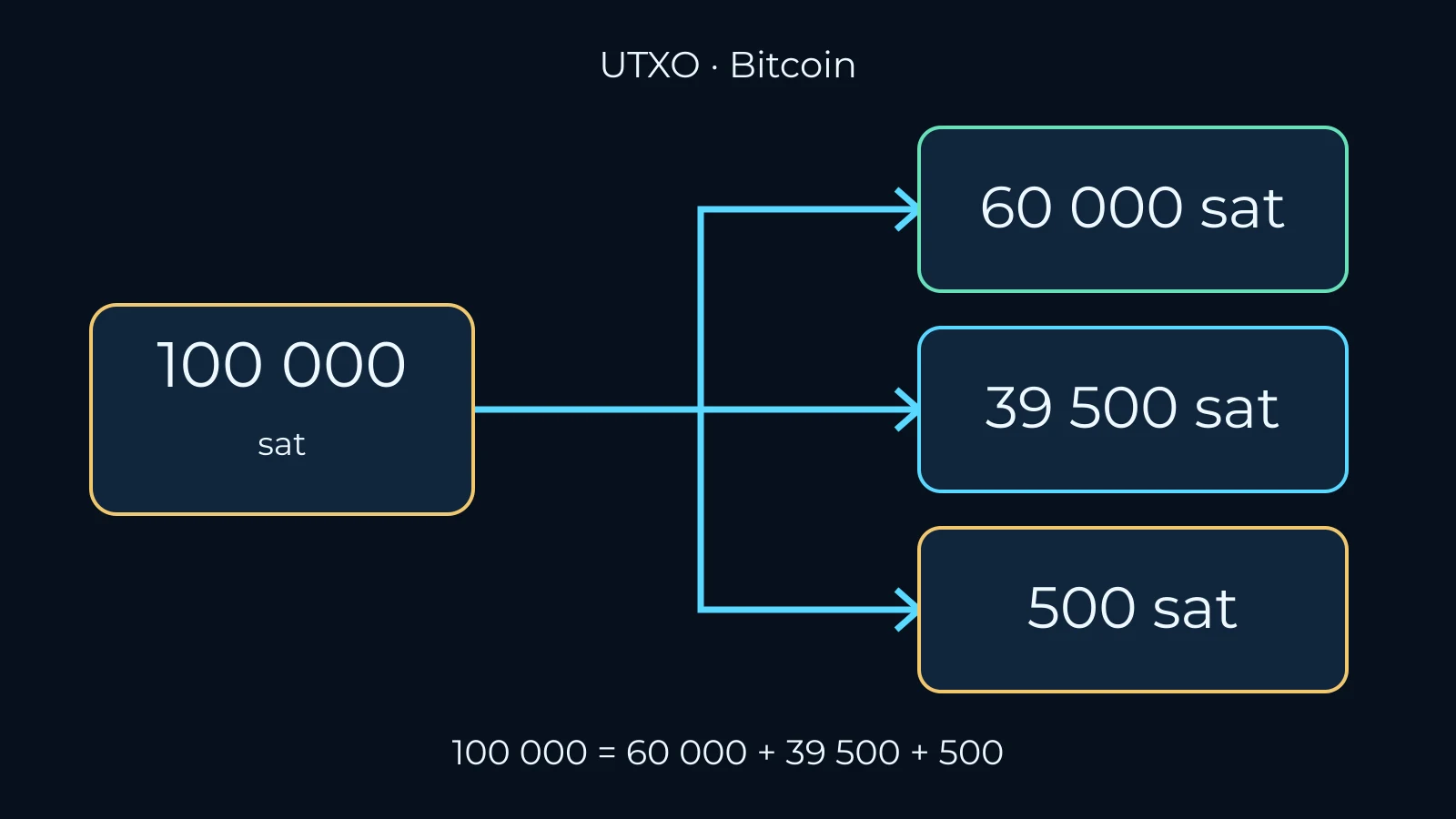
A Bitcoin balance sums unspent transaction outputs, or UTXOs. Spending consumes whole outputs and creates new ones for the recipient and often your change. Fees are the difference between input and output amounts.

Available outputs

A fresh output

Size × rate
Read the balance
Several receipts generally create several UTXOs. An explorer identifies each by its originating transaction hash and output index. The total balance does not reveal how many inputs your next payment needs.
Understand change
Hypothetical example: spend a 100,000-satoshi input to pay 60,000 with a 500 fee. Outputs are 60,000 to the recipient and 39,500 as change. Your wallet must control the latter; it is not an additional fee.
Estimate fees
A hypothetical quote of 140 vB at 5 sat/vB gives 700 satoshis. Inputs, outputs and scripts affect size; payment value does not directly set the fee. The rate estimates competition for block space, not a guaranteed confirmation time.
Select coins
Where supported, coin control selects UTXOs. Combining inputs can publicly associate previously separate receipts. Consolidating small outputs also costs fees; weigh privacy and future usefulness before doing it.
Check before signing
Verify recipient, amount, total fee and wallet recognition of change. A fresh change address is normal. Never send keys to a diagnostic tool or assume a low fee will confirm quickly.
A concrete verification
Inspect every output and change: the recipient amount alone does not describe use of inputs.
Hypothetical case: another input changes fees and change
Two outputs of 40,000 and 35,000 satoshis fund a hypothetical 60,000-satoshi payment. At an assumed 200 vB and 3 sat/vB, fees are 600 satoshis and change is 14,400. Different selection may alter size and fees. Satoshi arithmetic separates payment, fee and change; it checks neither scripts, addresses nor output availability.
- Compare total inputs and outputs: their difference should match the transaction fee.
- Check that change belongs to the wallet and complies with its policy.
- A very small remainder may be added to fees under wallet policy; do not assume a guaranteed change output.
Check a specific output on your own node
Bitcoin Core’s gettxout takes a transaction ID (txid) and an output index (vout). With the mempool included, a confirmed output can be absent if your node has a pending transaction spending it. Repeat the query with include_mempool set to false to inspect the confirmed state alone. Compare both responses before interpreting a null result.
Read the satoshi example
| Item | Value | Meaning |
|---|---|---|
| Input | 100 000 sat | Previous output consumed |
| Payment | 60 000 sat | Received by recipient |
| Change | 39 500 sat | New output belonging to your wallet |
| Fee | 500 sat | Difference between inputs and outputs |
Bitcoin calculator: payment, fee and change
Enter assumptions or your wallet’s estimate. All amounts are in satoshis. Initial values are hypothetical, not a current fee quote.
- Calculated fee (satoshis)
- Theoretical change (satoshis)
- Fee in BTC
- Change in BTC
Check positive whole amounts and virtual size, and a non-negative rate with at most three decimals. Payment plus fee must not exceed inputs.
Fee = round up virtual size in vB × rate in sat/vB. Change = inputs − payment − fee. 1 BTC = 100,000,000 satoshis.
Hypothetical example: 75,000-satoshi inputs, 60,000 payment, 200 vB and 3 sat/vB give a 600-satoshi fee and 14,400 change.
Size depends on inputs, outputs and scripts; it is not inferred from payment value. This model checks neither UTXO availability, addresses nor relay and change policies. A wallet may add a small remainder to fees. Zero or low rates guarantee neither acceptance nor timing. Use the wallet’s current estimate before an operation.
Formulas and units: Bitcoin documentation and BIP 141 : Bitcoin Developer Guide · BIP 141
Frequently asked questions
Is change lost?
No, when the change output belongs to your wallet. It becomes a new UTXO subject to its confirmation state.
Does the fee depend on the BTC amount?
Not directly: virtual transaction size and the chosen fee rate determine it.
Does consolidation improve privacy?
Not necessarily; it can expose links between inputs.
Verifiable sources
 Bitcoin Developer Guide: Transaction inputs and outputs
- Bitcoin Developer Guide: Wallets and coin selection
- Bitcoin BIP 141: Weight and virtual transaction size
- Bitcoin.org: Address reuse and privacy
- Bitcoin Core: Dust and relay policy
- Bitcoin Core: UTXO checks with or without the mempool
Independent educational content reviewed against primary documentation. No personalized recommendation or promise of returns. Updated November 15, 2026
Prepare and continue reading

Useful background
- Bitcoin and Ethereum: understand the differences
Bitcoin emphasizes native asset transfers with predictable issuance and proof of work. Ethereum also runs smart contracts and applications with proof of stake. Always verify the exact network and asset.
- Understand crypto fees and the amount actually received
Total cost can combine a price spread, service commission, payment, withdrawal and network fees. Always compare the amount debited with the net amount received in the same asset or currency at approximately the same time.

Continue to the next step
- Blockchain privacy: what is public, traceable or selectively disclosed
An address is not necessarily a name, yet its public history can be clustered and linked to identity through a service, reuse, publication or network metadata. Privacy is a set of practices, not a switch that guarantees anonymity.
- Full nodes: validation, syncing and maintenance
A full node applies validation rules to the chain it receives. It is neither a rewarded account nor a privacy guarantee; usefulness also depends on whether your wallet really uses it.