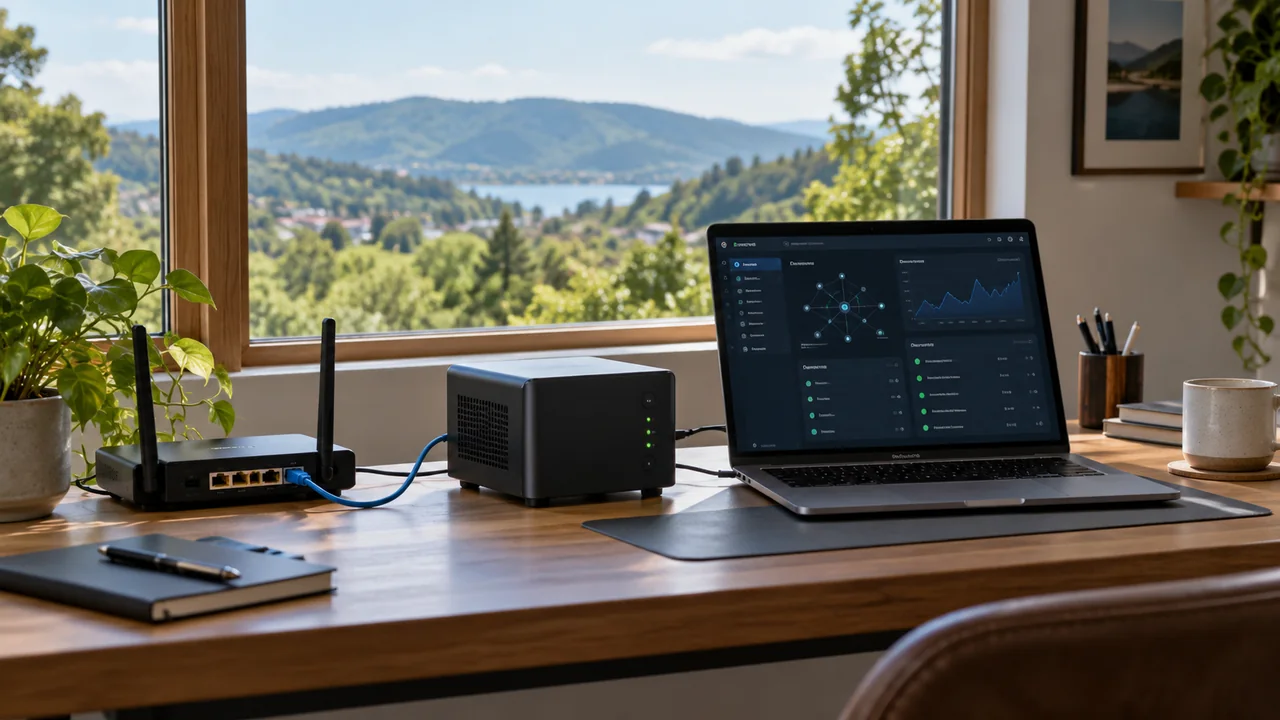
A full node applies validation rules to the chain it receives. It is neither a rewarded account nor a privacy guarantee; usefulness also depends on whether your wallet really uses it.

Independent validation

Storage and initial sync

Validate, then discard
Define the intended service
A Bitcoin node checks transactions, scripts and consensus rules rather than asking a third party which data are valid. It does not reveal people’s identities or guarantee recipient acceptance. Decide whether you want wallet verification, data serving or application development: each needs a different configuration.
Size the machine responsibly
The chain grows, so avoid hardware sizing based on an old blog figure. Check the chosen release’s requirements, data size, free-space margin, bandwidth and storage endurance. Initial synchronisation can heavily use processor and disk. A machine that starts successfully may still be unsuitable for reliable continuous operation.
Understand pruning
A pruned Bitcoin full node validates the chain and subsequently deletes older blocks to reduce storage. It does not become a light client merely by discarding those blocks. Historical queries and some wallet rescans may require missing data. Additional indexes and pruning are not universally compatible; inspect your release’s options.
Actually connect the wallet
Installing a node does not automatically change your wallet’s server. Check whether it queries your node directly, a local intermediary or external infrastructure. Bitcoin and Ethereum have different architectures; Ethereum validation includes execution and consensus components. Do not infer a configuration from branding.
Protect control interfaces
RPC interfaces can permit sensitive actions depending on exposed services. Apply authentication and network restrictions. Public chain data and wallet secrets are different: copying blocks does not back up keys. Test wallet recovery independently from server restoration. Record versions, configuration and restart steps without placing passwords in public documents.
Maintain the node
Monitor synchronisation, free space, availability and errors. Obtain releases from project channels and check authenticity using their instructions. Running an ordinary Bitcoin node does not automatically earn rewards; mining, Lightning routing and staked validation are separate activities. Privacy also depends on wallet queries, network connections and address reuse.
A concrete verification
Check the wallet’s actual server: an active local node does not prevent the application using a third party.
Hypothetical case: synchronized node, wallet connected elsewhere
A Bitcoin node finishes synchronization while the wallet still queries its default third-party server. The local node does not automatically validate information used by that wallet. Check its actual connection, synchronization indicators and broadcast method before attributing benefits to the installation. Pruning preserves validation while limiting access to some old blocks; plan restoration and rescans according to the software.
- Record software, version, wallet connection and observed state, not just “service started”.
- Keep RPC restricted and authenticated; public exposure is unnecessary for local consultation.
- Plan storage, wallet-specific backups and restart; a full node is not a universal key backup.
Chain history is not a wallet backup
A node validates rules and retains data according to its configuration; it does not replace wallet recovery material. Descriptors describe scripts and derivation paths, among other details. Some contain only public keys; others include private keys.
- Treat a descriptor containing a private key as secret material.
- Keep the reconstruction parameters required, not just a known address.
Worked example: restoring with a pruned node
An old wallet may require scanning historical blocks that a pruned node no longer retains. Having a validated current state does not mean having all the history needed for that search.
- Check the software version, wallet creation date and required blocks.
- Do not delete the old installation before understanding and testing recovery.
- For imported keys, the scan start must account for their earlier use, not merely the creation date of the restored file.
Verify the Bitcoin node your wallet actually uses
In Bitcoin Core, getblockchaininfo reports the network (chain), the validated block count (blocks), known headers (headers) and the initial sync indicator (initialblockdownload). Compare blocks and headers, then check that the chain tip is recent and the wallet uses this node. On a pruned node, pruneheight is the oldest block height still retained. Check that limit before planning a historical rescan.
Scenarios and model limits
| Situation | Interpretation |
|---|---|
| Pruned full node | Validates the chain; limited historical retention. |
| Archival node | Retains data; greater storage requirement. |
| Externally connected wallet | Installing a node does not automatically change the server. |
Frequently asked questions
Does pruning reduce validation?
Bitcoin pruning reduces block retention after validation. It constrains historical uses without inherently removing full validation.
Does my wallet automatically use my node?
No. Check its settings and the actual queried server.
Does a node replace key backups?
No. Blockchain data do not contain your secrets or reconstruct a lost private key.
Verifiable sources
 Bitcoin.org: Running a full node
- Bitcoin Developer Guide: Operating modes
 Ethereum.org: Nodes and clients
- Bitcoin Core: Output descriptors
- Bitcoin Core 30.0: Descriptor import timestamps and rescanning
- Bitcoin Core: Sync status and pruning information
Independent educational content reviewed against primary documentation. No personalized recommendation or promise of returns. Updated November 15, 2026
Prepare and continue reading

Useful background
- Understand blockchain simply
A blockchain is a shared ledger whose history is stored and checked by multiple computers. Transactions are signed, broadcast, verified and grouped into blocks under common rules. It does not make every user anonymous or every application safe.
- Blockchain privacy: what is public, traceable or selectively disclosed
An address is not necessarily a name, yet its public history can be clustered and linked to identity through a service, reuse, publication or network metadata. Privacy is a set of practices, not a switch that guarantees anonymity.
Continue to the next step
- How to read a transaction in a block explorer
Copy the transaction hash from your wallet, open a trusted explorer for the correct network, then compare status, addresses, asset, amount, fees and confirmations. Never enter a recovery phrase.
- Bitcoin: UTXOs, change and transaction fees
A Bitcoin balance sums unspent transaction outputs, or UTXOs. Spending consumes whole outputs and creates new ones for the recipient and often your change. Fees are the difference between input and output amounts.